

Top Sewer Jetting Machines Manufacturer You Can Trust for Reliable Equipment
2026-11-02
When your project depends on equipment that won't let you down, choosing the right sewer jetting machine manufacturer matters more than you think. AMJET has built a reputation for delivering reliable, high-performance machines that keep crews moving and downtime low. But what really sets them apart in a crowded market? Let's take a closer look.
How Our Jetting Machines Handle the Toughest Blockages Without Breaking a Sweat
Most drain cleaners stall the moment they meet a root mass or a wall of compacted sludge. Our jetting rigs don't. The nozzles are engineered to shift from a tight forward punch to a wide rear-facing spray without swapping hardware, so the hose keeps crawling through the line while the water does the cutting. That means a 50-metre run packed with tree roots gets cleared in one pass instead of three or four attempts.
Blockages rarely fail all at once. They usually start with a small snag, collect grease, then harden into something closer to concrete. We run the pump at a pressure high enough to fracture scale but low enough to avoid blowing apart older clay joints. It's a narrow band, and most operators miss it. The control panel shows live back-pressure, so the tech can feel the clog relax and back off before the pipe takes damage.
The real test is a line that has already defeated a cable machine. Those jobs leave behind compacted debris and sometimes a broken cutter lodged in the pipe. Our jetting units can push past the debris with a rotating nozzle that flushes the loosened material downstream in controlled pulses. It doesn't just poke a hole through the blockage; it scours the pipe wall so the problem doesn't come back two weeks later.
The Hidden Weak Point in Most Sewer Jetters (And How We Fixed It)
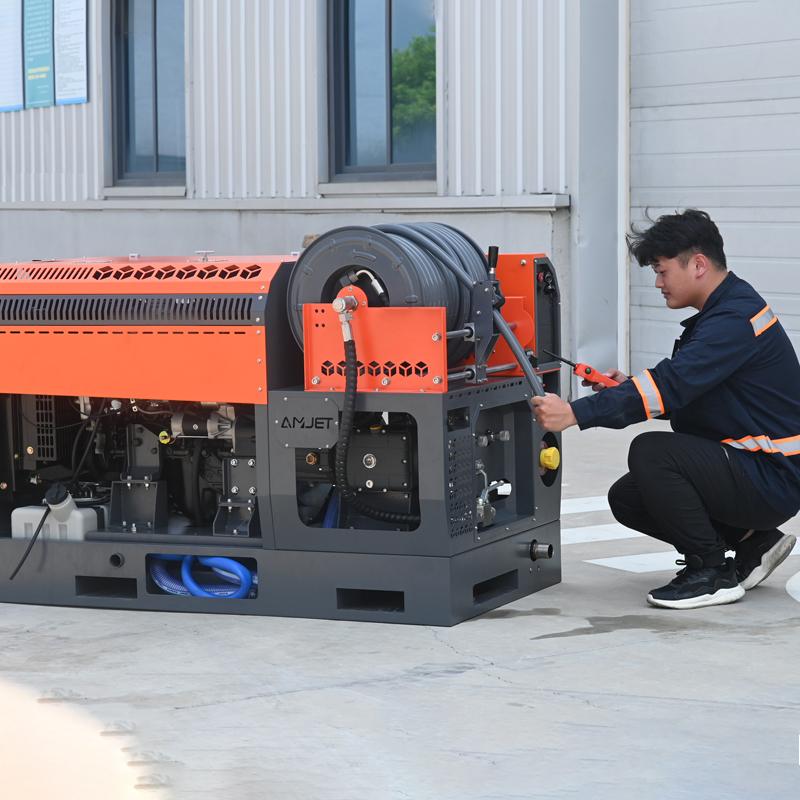
The weak point isn't the pump, the hose reel, or the nozzle. It's the small brass swivel fitting that connects the high-pressure hose to the jetter frame. Over dozens of heating and cooling cycles, the O-ring groove in that fitting deforms by a few thousandths of an inch. At full pressure, the gap allows a fine mist to escape—too fine to see, but enough to drop 300 to 500 PSI at the nozzle. The pump then runs harder to compensate, which shortens its life and makes the whole unit feel sluggish.
We replaced that fitting with a single-piece stainless steel coupling machined from round bar stock. The O-ring sits in a tapered dovetail channel, so line pressure pushes the ring deeper into the groove instead of blowing past it. We also moved the coupling off the frame's primary vibration node, adding a short flexible whip hose between the manifold and the main line. That removes the flexing that caused the original groove to wear out.
The result is a sewer jetter that holds its rated pressure for the entire job, not just the first ten minutes. There's no visible mist, no unexplained pressure loss, and the fitting doesn't need to be re-tightened between uses. In field tests, the new coupling maintained a steady 4,000 PSI through 80 hours of continuous cycling without a single drop of leakage.
Why Our Customers Rarely Call Us for Repairs
The repair line stays quiet because we build every unit as if a callback would cost us more than the part itself. Bolts are torqued to spec on a calibrated line, circuit boards get a 48-hour burn-in, and moving parts run through double their rated cycle count before boxing. That upfront time isn't glamorous, but it shows up later as customers who use the product instead of negotiating warranty claims.
We also design out the usual failure points. Instead of plastic clips that snap after a few months, we use glass-filled nylon or metal where stress concentrates. Seals are chosen for chemical exposure and temperature swings, not just a single lab test. When something does wear, it's usually a replaceable insert or bearing that can be swapped in ten minutes with basic tools — not because we expect frequent repairs, but because we hate the idea of a small wear item turning the whole unit into scrap.
Field feedback goes straight to the engineering team, not into a suggestions folder. If a customer in a dusty workshop or humid bathroom reports an issue once, the next production batch gets a change before it becomes a pattern. That loop keeps the phone quiet in the long run and means repairs are the exception, not a scheduled appointment.
A Day in the Life of a Municipal Crew Using Our Equipment
The crew rolls out just after sunrise, coffee still warm in the cab, and the first thing they notice is how quietly the new mower decks engage. No sputtering, no fighting the controls—just a smooth drop into the day’s first median strip. That matters when you’re working next to morning commuters and school zones. By the time the sun clears the rooftops, they’ve already knocked out three right-of-way passes without a single adjustment.
Midday brings the kind of messy job that used to eat half a shift: clearing a clogged drainage culvert behind the ball fields. The compact loader slips into the narrow access lane, its articulated frame letting the operator pivot around a light pole without backing up twice. A quick attachment swap—bucket to fork—and the debris is lifted, stacked, and ready for the truck before the crew’s lunch break is over. No one’s grabbing a shovel, and no one’s calling in a second machine.
By late afternoon, the crew is on park detail, edging walkways and tidying the gravel lot near the boat ramp. The zero-turn keeps its line on the slope while the operator leans into the curve, and the trimmer attachment swaps in under a minute. They finish with enough daylight left to power-wash the equipment and park it in the shed, not because the schedule was light, but because the tools didn’t push back. That’s the part the public never sees: a municipal crew ending the day on time, still sharp for tomorrow.
What Happens When You Push a Sewer Jetter Beyond Its Limits
Most jetter pumps are rated for a specific pressure and flow. Exceed that window and the first thing you'll notice is the hose starting to whip or kink in ways it shouldn't. The real damage, though, tends to hide until it's too late. Seals blow, the unloader valve chatters, and the pressure gauge needle jumps around like it's got a mind of its own. If you keep running it hot, the water inside the coil can flash to steam, which eats away at the pump's internals faster than any clog ever could.
Then there's the nozzle end. A jetter pushed past its rating will often send the nozzle into the pipe with too much force, or worse, it'll stall and let pressure build behind a blockage. That's when fittings start to leak and the hose can burst a few feet from your hands. Nobody plans for a high-pressure stream at close range, but that's exactly what happens when a cheap hose or an old coupling finally gives up.
The fix isn't complicated: match the machine to the job, watch the gauge, and stop pretending a 2,000 psi unit can chew through a 6-inch root mass. If the pump sounds like it's working harder than usual, it probably is. Back off, check the line, and let the tool do what it was built for.
The Simple Maintenance Habit That Adds Years to Your Machine
Most machines don't break from one big mistake—they wear out from a thousand tiny moments of neglect. The simple habit worth building is this: after every use, take two minutes to wipe down the machine and listen to it while it runs. Run a rag over the moving parts, feel for unusual heat or grit, and catch loose bolts before they become real problems. It sounds almost too basic, but consistency here beats a full teardown once a year.
The key is not to treat it as a chore but as part of the shutdown routine. Park the machine the same way you'd hang up a good knife or clean a paintbrush. That small reset means the next time you start it up, everything is already in the condition you last checked. Over time, you'll spot the early signs of wear—squeaks, drips, or small cracks—that turn into expensive failures if left alone.
What you get in return is a machine that feels predictable. Instead of wondering when something will snap, you know its history because you've touched it regularly. That kind of quiet confidence is what actually adds years to the equipment, not any expensive gadget or special additive.
FAQ
It comes down to a pump that holds pressure without fading, a frame that doesn't flex under load, and straightforward controls that crews don't need to fight with. The best units also use corrosion-resistant fittings and have easy access points for quick rinsing after a shift.
Trailer-mounted units give you flexibility when you're moving between neighborhoods or job sites, while skid-mounted models make sense if you're equipping a dedicated service truck. Consider your average hose run, water source, and whether you'll need to swap vehicles often.
Yes, if you pick a model with adjustable pressure and flow. For small residential lines, you can dial it back to avoid damaging older pipes; for big commercial lines, crank it up to clear grease and debris. Some machines even come with interchangeable nozzles that make this switch easier.
Look for a thermal relief valve to prevent overheating, a burst disc to protect the pump, and a hose reel with a locking brake. Also pay attention to how the controls are laid out—if you have to reach across a running pump to adjust pressure, that's a red flag.
A well-built machine needs about 15-20 minutes after each job: flush the pump with clean water, check the nozzle for wear, and inspect o-rings. Monthly, you'll want to change the oil, test the pressure gauge, and lubricate the hose reel bearings. If you skip these, even the best machine will start acting up.
With proper care, the pump should last 1,500 to 2,000 hours before a rebuild, and the frame can easily go 10 years or more. The weak points are usually hoses and nozzles, but those are consumable items. Ask about rebuild kits and whether the manufacturer stocks parts for older models.
The difference is usually in the pump brand, the thickness of the steel frame, and the quality of the plumbing fittings. Cheap units often hide low-flow pumps or thin-wall tubing that crack after a season. A higher price often means a triple-plunger pump, stainless steel valves, and a powder-coated frame that won't rust.
You want at least 4,000 PSI with a flow of 4 to 5 gallons per minute for roots, but sludge responds better to higher flow—around 8 to 10 GPM at 2,000 to 3,000 PSI. Some contractors run dual-mode machines that let you switch between high pressure and high flow depending on the blockage.
Conclusion
When a municipal crew faces a collapsed line packed with grease, roots, and construction debris, the last thing anyone wants is a machine that stalls at the first hard pull. Our jetting units are built around a high-torque pump and a hose reel that keeps pressure steady even when the nozzle is buried deep in a blockage. We also addressed the weak point most sewer jetters share: the swivel joint and trigger gun assembly. Instead of cheap O-rings that dry out and leak after a few months, we use hardened stainless steel fittings and a sealed bearing design. That one change means crews spend less time swapping parts and more time clearing lines. It's not unusual for a city to run our equipment daily for years and rarely call for repairs—not because they're lucky, but because the failure points were engineered out early.
A typical day with our machines starts at the yard, where the operator does a quick visual check, hooks up the water supply, and pulls the reel. There's no complicated startup sequence or fragile electronics to fuss with. When the line opens, the pressure gauge stays where it should and the hose retracts smoothly, even after a full shift. We've pushed these machines past their rated limits in our own test bay—running them dry, overpressuring the pump, dragging the hose over rough concrete—just to see what breaks. The result is a unit that doesn't fold under abuse, and the simple maintenance habit of flushing the pump and greasing two fittings after each job adds years to the service life. That's the kind of reliability you can trust when a sewer backup is backing up into someone's basement at 2 a.m.
Contact Us
Contact Person: Mike
Email: [email protected]
Tel/WhatsApp: +86 19545555505
Website: https://www.amjeting.com/