

Pet Hardware Supplier Guide to Durable Collar Buckles and Leash Clips
2026-10-30
Hardware failure on a leash or collar isn’t just a nuisance—it can mean a lost dog, a liability claim, or a ruined brand reputation. That’s why sourcing buckles and clips from a supplier who treats durability as engineering, not marketing, matters. Kingming has spent years refining the materials, tolerances, and finishes that keep pet hardware reliable under real-world stress. This guide walks through what to look for—and what to avoid—when choosing collar buckles and leash clips for your product line.
Why Cheap Buckles Fail Before the Collar Does
Most budget buckles are molded from a brittle polyoxymethylene blend that gets the shape right but skimps on impact resistance. The collar webbing can take thousands of flex cycles without losing much strength, yet that plastic tongue and frame are constantly fighting torsion from a pulling dog. A cheap buckle often snaps at the base of the prong where cooling lines left a microscopic seam—an invisible weak point that becomes a crack after a few months of daily walks.
Then there's the way low-cost hardware handles temperature swings. Nylon webbing expands and contracts gently, but a stiff acetal buckle doesn't forgive the same movement. In cold weather the plastic becomes glassy; a sudden jerk on the leash sends stress straight to the corners of the frame rather than spreading through the strap. Repeated thermal cycling plus UV exposure creates surface crazing that you can feel with a fingernail long before the fabric shows any wear.
Quality collars often outlive two or three cheap buckles because the metal or reinforced polymer hardware is made to flex with the load instead of resisting it. The failure isn't a coincidence of abuse—it's a material choice that puts the weakest part right where the force concentrates.
The Hidden Weak Points in Most Leash Clips
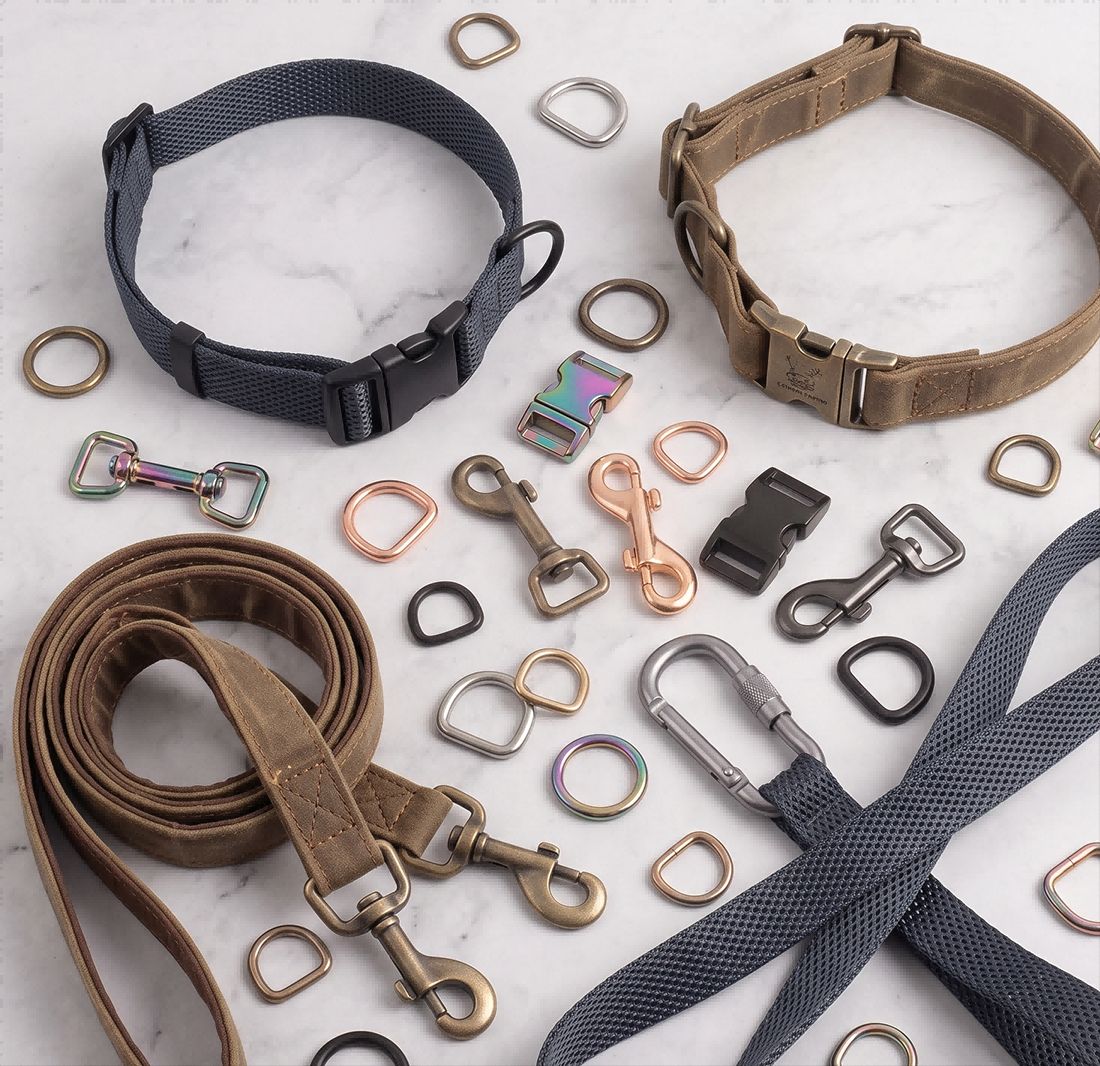
Most failures don’t come from the gate snapping in two. They start in the swivel. A standard leash clip has a tiny barrel joint meant to let the strap rotate freely, but after a few walks on sand, grit works its way into that joint. What begins as a subtle grinding feel turns into a catch-and-release that yanks the dog’s collar with every stride. Once the swivel stops rotating, the leash twists instead, and that constant torque slowly loosens the rivet holding the gate hinge together.
The spring inside the gate is another overlooked weak spot. It’s often just a thin strip of bent metal housed under a small cover. If a dog lunges hard, the gate can flex outward for a split second—long enough for a flat D-ring to slip free if it’s angled just right. You won’t notice it during normal use, because the spring still returns the gate to closed. But over time, that split-second gap grows wider as the spring loses tension, until one sudden jerk pops the clip clean off the collar.
Then there’s the material itself. Many budget clips are cast from zinc alloy and plated to look like stainless steel. The plating hides stress cracks that form near the gate hinge, especially after winter walks when road salt sits in the crevices. A clip that looks fine on the outside can shear at the hinge without warning. If the clip has a plastic-coated body, rust often spreads underneath the coating, making the failure even harder to spot before it happens.
Alloy Choices That Balance Toughness and Comfort
Riders often assume a stiff alloy frame is the only way to get real power transfer, but that kind of rigidity rattles through the handlebar and saddle on rough pavement. A smarter approach is to blend thicker-walled down tubes with thinner seat stays, so the drivetrain feels direct while the rear end absorbs chatter before it reaches your body.
Alloy selection matters just as much as tube shaping. 6061 aluminum can be heat-treated for high strength, but it tends to transmit vibration unless paired with a carbon fork or wider tires. 7005 aluminum, by contrast, offers a slightly softer ride character while still resisting denting and fatigue. Some builders also mix in scandium to reduce wall thickness without sacrificing toughness, which trims weight and lets the frame flex in a controlled way. The goal is not to eliminate stiffness entirely, but to put it where pedaling forces are highest and remove it from contact points.
Field-Testing Hardware Before It Reaches Store Shelves
Before any hardware earns a spot on store shelves, it goes through a gauntlet of real-world abuse. Engineers strap prototypes to truck beds, expose them to salt spray, and drop them onto concrete to see what fails first. The goal isn't to confirm the design works—it's to break it in ways the lab couldn't predict.
Out in the field, temperature swings and vibration reveal weak solder joints and loose fasteners that bench tests miss. A drill that performs flawlessly in a climate-controlled room might seize up after a week on a dusty construction site. Field testers log every hiccup, from battery drain anomalies to subtle handle cracks, feeding that data back to the design team before the first production run.
The final round often involves handing early units to actual tradespeople or outdoor enthusiasts who don't follow instructions gently. They toss tools into truck boxes, leave gear in freezing garages overnight, and yank cords at odd angles. Only after surviving this unscripted torture does a product get the green light for retail packaging—because a warranty claim costs far more than a delayed launch.
Coatings That Survive Salt, Mud, and Daily Wear
Salt has a way of finding every microscopic breach in a surface. These coatings don’t rely on a single barrier; they form a dense, cross-linked film that blocks chloride ions before they can reach the metal or substrate underneath. In coastal yards and on roads treated with de-icing salts, that means no rust blooms around edges or fasteners after the first winter.
Mud is a different kind of abrasive—it packs into crevices, holds moisture, and grinds away at softer finishes every time a vehicle or boot moves. The topcoat here is formulated with a slight flexibility, so it takes the scuff and flex without cracking. You can hose off dried silt and still find the color depth intact, not faded or hazed from repeated scraping.
Daily wear comes from keys, tools, branches, or just the slow rub of use. What separates these finishes is their cure schedule: they reach a hardness that resists marring but stop short of becoming brittle. The result is a surface that looks worked-in rather than worn-out, holding its gloss or matte tone through years of ordinary abuse.
What to Ask a Factory Before Placing a Repeat Order
Before you re-up with a factory, ask for the exact specs of the last production run and any deviations they logged. Confirm whether the raw material batch, thread count, or component suppliers shifted since your previous order. Get them to walk you through their current inline and final inspection checklists, not just the summary report.
Then push on capacity and timeline. Ask which production lines are currently running and how many other clients they're juggling. Request a realistic shipping window with buffer days, and clarify who covers air freight if they miss the boat. Also ask if the same supervisor and QC team will handle your repeat order—staff turnover can quietly change output quality.
Finally, talk money and terms. Ask for a line-item cost breakdown to see what changed and why. Nail down payment schedule, defect policy, and rework responsibilities before signing. If they hesitate on any of these, that's your cue to audit their floor or hold off.
FAQ
Focus on the gate design first. A buckle with a reinforced, spring-loaded gate tends to resist twisting when a dog lunges or rolls. Also check the thickness around the strap slot—thin edges there can crack under repeated tension. Solid brass or investment-cast stainless steel usually outperform zinc alloy in high-impact play, though a good zinc alloy with a thick cross-section can still work for lighter dogs.
Zinc alloy is lighter on the collar and cheaper to produce, but it is softer and can deform if a strong dog hits the end of a leash hard. Stainless steel holds its shape better and resists corrosion, yet it adds weight and cost. For most everyday collars, a quality zinc alloy with a durable coating is fine. If the dog swims often or pulls heavily, stainless is worth the extra expense.
Electroplating alone rarely lasts on clips that rub against rings and D-rings. A powder coat or PVD finish tends to survive much longer because it bonds more tightly to the metal. For stainless parts, a light tumble polish removes micro burrs that can snag fabric or skin. Avoid painted finishes on high-wear areas—once the paint chips, the exposed metal starts to corrode and the clip looks worse than a plain matte finish.
Ask for dynamic pull tests, not just static weight ratings. A buckle that holds 200 pounds hanging still can fail at half that force if the load is sudden, like a dog sprinting to the end of a leash. Salt spray testing is also important for any hardware used near water. Reputable suppliers can provide batch test reports matching the exact mold or casting run, not a generic sheet from a different product.
Side-release buckles are easier to open one-handed, which helps in grooming or vet visits. Center-bar buckles, often seen on martingale or limited-slip collars, stay more secure when the dog backs up or shakes. If the collar is meant for training or escape-prone dogs, the extra security of a center-bar design outweighs the convenience factor. For everyday flat collars, a side-release with a robust gate is usually the practical choice.
Start with 316 stainless rather than 304 if the dog regularly swims in the ocean. Even then, rinse the hardware with fresh water after exposure—salt crystals grind into moving parts and accelerate wear. Avoid plated carbon steel entirely for beach products; it will rust within weeks. A periodic silicone spray on the spring area can also keep the gate action smooth without leaving a greasy residue on the collar.
Request the actual mold or casting number for the buckle and clip, not just a photo from a catalog. Ask what alloy is used and whether the factory can supply a material certificate for each batch. Clarify the tolerance on the spring gate—too loose and the clip pops open, too tight and owners struggle to attach it. Also confirm the finish thickness and whether the factory tests for lead and cadmium, since those details matter for safety compliance.
Conclusion
Most collar failures trace back to the buckle, not the webbing. Cheap zinc or thin stamped steel buckles snap under sudden pulls, while the collar fabric remains perfectly intact. That mismatch isn't random—it's a design weakness. Reputable suppliers focus on alloy blends that combine toughness with a smooth, comfortable edge, such as marine-grade stainless or coated aluminum. But material alone isn't enough. Each batch should be yanked, twisted, and salt-sprayed before it ships. That kind of field testing catches hidden weak points, like a gate spring that loses tension after a few hundred clips or a casting seam that cracks under load.
Surface coatings matter more than most buyers expect. A shiny finish might look great in a catalog, but if it chips after a week of salt, mud, and daily wear, the hardware corrodes and the customer blames the collar. The right coating—whether powder coat, anodizing, or a high-quality electroplate—needs to survive abrasion and chemical exposure without flaking. When reordering, ask the factory specific questions: what’s the exact alloy grade, how many cycles did the clip endure in fatigue testing, and can they provide batch-level coating adhesion reports? Vague answers are a red flag. Durable hardware comes from suppliers who treat each component as a load-bearing part, not an afterthought.
Contact Us
Contact Person: Jamie Zeng
Email: [email protected]
Tel/WhatsApp: +86 13728219269
Website: https://www.kmhardware.com