

Leading Industrial SLA 3D Printer Manufacturer Drives Manufacturing Innovation
2026-06-13
In an era where precision and speed define manufacturing success, one name is reshaping the industrial landscape: ProtoMat. As a leading SLA 3D printer manufacturer, ProtoMat isn't just producing hardware—it's driving a fundamental shift in how industries prototype, produce, and innovate. From aerospace to healthcare, their technology is unlocking possibilities that once seemed out of reach. But what sets ProtoMat apart in a crowded market? Let's explore how their advanced stereolithography solutions are turning bold ideas into tangible realities, one layer at a time.
Rethinking Production: Industrial SLA Enters High-Volume Manufacturing
For years, stereolithography was pigeonholed as a prototyping technology, too slow and expensive for anything beyond low-volume runs. But the landscape has shifted dramatically. Recent advances in hardware, materials, and process control have quietly elevated industrial SLA into a legitimate contender for high-volume manufacturing. Print speeds once measured in millimeters per hour are now orders of magnitude faster, thanks to innovations like continuous liquid interface production and high-powered laser arrays. Meanwhile, new engineering-grade resins deliver mechanical properties that rival injection-molded thermoplastics, with durability, heat resistance, and surface finish that require no post-processing for many applications.
The real breakthrough, however, isn’t just faster printers or stronger materials—it’s the integration of SLA into automated production lines. Modern systems handle everything from resin dispensing and part removal to washing and curing with minimal human intervention. This lights-out capability means a single operator can oversee a fleet of machines churning out thousands of end-use components per day. The economics have flipped too: when you factor in the elimination of tooling costs and the ability to iterate without penalty, the per-part cost often undercuts traditional methods for batches reaching into the tens of thousands. Automotive, consumer electronics, and medical device companies are already capitalizing on this, using SLA for everything from intricate connectors to custom-fit headsets.
Perhaps most importantly, high-volume SLA is redefining what’s possible in design and supply chain. The technology unlocks complex geometries, lightweight lattices, and consolidated assemblies that would be impossible or prohibitively expensive to mold. Production can be distributed across multiple facilities, drastically reducing lead times and inventory risk. Instead of warehousing thousands of identical parts, manufacturers can print on demand, tailoring each piece without slowing down the line. It’s not just a new way to make things—it’s a fundamentally more responsive and adaptable production model.
Precision at Scale: The Engineering Behind Modern SLA Printers
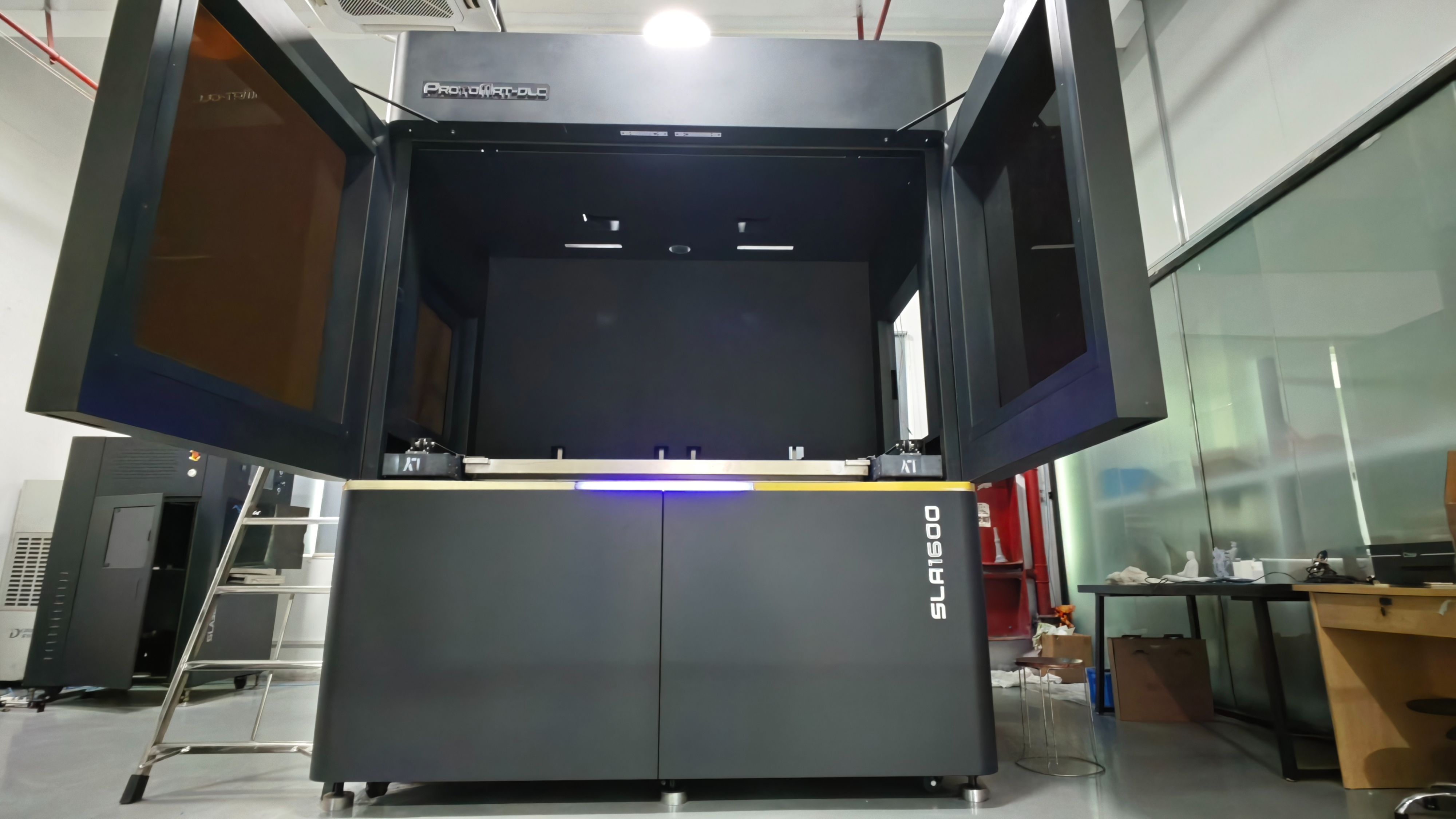
Achieving micron-level precision in SLA printing isn't just about a high-resolution laser—it's a careful orchestration of optics, motion control, and material science. Modern printers use galvanometer-driven mirrors to steer a UV laser beam across the resin surface with sub-pixel accuracy, often calibrated with closed-loop feedback that corrects for thermal drift and mechanical play. The optics path is sealed and temperature-stabilized, while advanced printers like the Formlabs ecosystem employ a flexible light-processing unit that adapts beam profile in real time to maintain consistent curing depth across the entire build area, even at the edges where beam angle distortion would otherwise compromise feature fidelity.
Scaling this precision from a single part to a full build volume introduces a different class of engineering problems. The peel mechanism, for instance, must exert enough force to detach the cured layer from the vat film without distorting delicate structures—a challenge solved by angled tanks, low-adhesion films, and precisely timed tilt or slide motions that reduce peak separation forces. Industrial-scale SLA printers like the 3D Systems ProX integrate adaptive slicing algorithms that vary layer thickness based on geometry, printing thick layers in monolithic regions and thin layers on overhangs, maximizing throughput while preserving detail. Resin temperature is actively managed with heated vats and recirculation systems to avoid viscosity shifts that would alter recoater performance, ensuring that the first print of the day is as consistent as the hundredth.
The frontier of SLA engineering lies in multi-laser systems and in-process monitoring. By splitting the build area into quadrants and assigning dedicated laser modules, manufacturers can parallelize exposure without sacrificing resolution, significantly cutting cycle times. High-speed cameras and interferometers are now embedded to detect layer defects as they occur, enabling the printer to adjust parameters or halt before a failure cascades. These advancements aren't just incremental tweaks—they represent a shift from open-loop curing to a responsive, feedback-driven process that treats each layer as an individually engineered slice, ultimately pushing SLA from a prototyping tool into true production workhorse.
Sustainable Practices: Reducing Waste with Additive Manufacturing
Additive manufacturing flips the script on traditional production, where materials are typically carved away and discarded. By building objects layer by layer, it uses only the material that ends up in the final part, slashing waste at the source. This approach isn't just about trimming scraps from the factory floor—it reshapes how we think about resource use from the design stage onward.
Another quiet shift happens in the supply chain. Instead of mass-producing components overseas and shipping them across the globe, companies can now print parts on demand, closer to where they’re needed. This slashes packaging waste, excess inventory, and the carbon tied to freight. It’s a local-for-local model that chips away at the hidden waste streams most consumers never see.
Repair and reuse also get a boost. When a single component breaks in a complex product, additive manufacturing makes it possible to produce that one piece instead of replacing the entire assembly. This extends the lifespan of everything from industrial machinery to household appliances, quietly keeping materials in circulation longer.
From Days to Hours: Accelerating Time-to-Market with 3D Printing
Traditional manufacturing often traps brilliant ideas in a labyrinth of delays—weeks spent waiting for tooling, multiple design iterations bouncing between continents, and supply chain hiccups that push launches past the point of relevance. 3D printing slashes through those roadblocks. Without needing specialized molds or fixtures, a design that was finalized on Monday can be sitting in your hands by Tuesday afternoon, ready for testing. This immediacy doesn’t just save time on paper; it empowers teams to fail fast, learn quickly, and refine relentlessly, transforming a process that once stretched over months into a sprint that unfolds in days.
Consider the impact on competitive positioning. When a market opportunity emerges, being first often means the difference between setting the standard and chasing it. Additive manufacturing lets you compress iterative prototyping and even initial production runs into a single, fluid workflow. You’re no longer shackled by the rhythm of outsourced machine shops or minimum order quantities. Instead, you can produce small batches in-house, gather real user feedback, and pivot almost instantly—shaving weeks off every validation cycle. What used to require 12 weeks might now take two, turning time-to-market from a vulnerability into a strategic weapon.
This acceleration ripples far beyond the engineering department. Marketing teams get physical samples early enough to craft compelling campaigns. Sales teams can demonstrate functional units instead of glossy renderings. Investors see tangible progress rather than ambiguous timelines. The entire organization aligns around velocity, and that speed becomes embedded in the company’s culture. 3D printing doesn’t just manufacture parts faster—it manufactures opportunity, turning the old “good things take time” adage into a relic of a slower era.
Cross-Industry Breakthroughs: Where SLA Printing Makes the Difference
SLA printing is quietly reshaping how medical teams plan complex surgeries. By turning CT scans into life-size, translucent anatomical models, surgeons can rehearse tricky procedures on a patient's unique vasculature before ever making an incision. A cardiac unit in Germany cut operation times by nearly 40% after adopting these guides, simply because the team could see exactly where to navigate around fragile tissues. That kind of precision isn't just handy—it's changing survival rates.
In automotive prototyping, the speed of SLA remains unmatched when engineers need to test a new headlight housing or dashboard component overnight. A single print can capture both the optical clarity of a lens and the subtle texture of a switch, letting designers evaluate form and function side by side without assembling multiple parts. The cost savings stack up fast too: iterating on a CAD model with an in-house SLA machine avoids the week-long wait and tooling costs of outsourcing.
But perhaps the most unexpected wins come in consumer goods, where jewelry makers and footwear designers exploit SLA's ability to hold micro-fine details. One independent studio now prints custom earring molds with lattice structures so delicate they would collapse under any other process, then casts directly into metal. The result is a product line that simply couldn't exist a decade ago, and customers are willing to pay a premium for that individuality.
The Autonomous Factory: Merging SLA Technology with Industry 4.0
SLA-based additive manufacturing is shedding its prototyping skin and stepping directly onto the connected factory floor. In the autonomous factory, networked SLA printers continuously receive digital twins of parts, adjust build parameters on the fly from real-time material feedback, and dispatch finished components to automated post-processing cells with zero human handoff. This shift fundamentally blurs the line between design intent and physical output, turning software loops into physical production cadences.
Rather than treating SLA as an isolated 3D printing island, Industry 4.0 frameworks wrap each machine in a data-rich envelope of sensors, edge analytics, and cloud connectivity. Resin batches self-report their viscosity and cure kinetics, build platforms log every layer’s illumination profile, and distributed fleets share failure patterns across factories. The result is a self-correcting system where quality deviations trigger immediate recipe adjustments, and capacity planning becomes a living process driven by live order books instead of static schedules.
This convergence also collapses the traditional supply chain into an on-demand, localized loop. Autonomous factories using SLA can stock digital inventories of spare parts and print them beside the assembly line when signaled by IoT-enabled devices. Post-processing robots wash, cure, and inspect without manual crating or shipping delays, so lead times compress from weeks to hours. It’s a quiet but profound transformation: a factory that no longer merely makes things, but actively orchestrates material, data, and energy in a closed, responsive circle.
FAQ
Their commitment to precision engineering and continuous innovation has set them apart, enabling manufacturers to produce highly detailed parts with unmatched accuracy and surface finish.
SLA allows for rapid prototyping and production of complex geometries that were previously impossible, accelerating design cycles and enabling new product categories in automotive, medical, and consumer goods.
They support a wide range of advanced photopolymers, including high-temperature, flexible, and biocompatible resins, giving engineers the freedom to choose materials that meet their exact functional requirements.
From custom surgical guides in hospitals to lightweight components in motorsport, the printers have been instrumental in creating end-use parts and tooling that demand both precision and durability.
Comprehensive onboarding programs, on-site installation, and ongoing technical support ensure that teams can integrate the technology smoothly and maximize productivity from day one.
By optimizing resin usage and developing recycling programs for waste materials, they help manufacturers reduce their environmental footprint while maintaining high production standards.
Unlike filament-based printers, SLA offers superior detail resolution and isotropic parts, making it ideal for functional testing and end-use applications where surface finish and accuracy are critical.
Their machines feature closed-loop control systems and in-process monitoring, which maintain stringent tolerances and repeatability, even in 24/7 manufacturing environments.
Conclusion
A major player in industrial stereolithography is reshaping how manufacturers think about production. Its latest SLA systems don’t just prototype—they run high-volume manufacturing lines with layerless precision and build speeds that compress days of work into hours. Behind that speed lies an engineering overhaul: advanced optics, closed-loop control, and smart material handling that deliver repeatable micron-level accuracy across entire batches. In aerospace, automotive, and medical device industries, that reliability has turned 3D printing from a niche tool into a core production method. Components that once required multi-step assembly are now printed as single, complex parts, eliminating joints and weak points while cutting lead times drastically.
But innovation doesn’t stop at speed and accuracy. Sustainability has become a design principle, not an afterthought. By using only the exact material needed and reclaiming uncured resin, these machines slash waste when compared to subtractive methods. The environmental footprint shrinks further when on-demand printing replaces warehousing and long-distance shipping. Looking ahead, the manufacturer is embedding SLA technology into the autonomous factory vision—tightly integrating with Industry 4.0 networks. Printers self-calibrate, monitor consumables, and hand off parts to robotic post-processing cells without human intervention. This convergence of digital precision, resource efficiency, and automation is not just upgrading manufacturing; it’s fundamentally redefining how products move from concept to customer.
Contact Us
Contact Person: Joe
Email: [email protected]
Tel/WhatsApp: +8613799507208
Website: https://www.3dprotomat.com/