

Knife Valve Factory Delivers Robust Solutions for Demanding Industrial Applications
2026-08-23
A single valve failure in a demanding process line isn’t just an inconvenience—it’s a shutdown, a safety risk, and a hit to your bottom line. That’s why DRIFCO takes a different approach. From our knife valve factory, we engineer robust, application-specific solutions that hold up under the harshest conditions. Here’s what that means for your operation.
When Slurries Clog the Line, These Valves Keep Moving
Slurries settle fast. Stop the pump for five minutes and you've got a settled bed of solids packed into every recess. Conventional gate valves are the first to seize—the wedge gets buried, the seats cake over, and the stem can't move. But some valves are built for exactly this mess. Knife gate valves use a sharp, beveled blade that slices through settled solids on every stroke. Pinch valves clamp a reinforced rubber sleeve, squeezing the slurry and breaking any crust that forms inside. Both designs keep the flow path wide open when fully cycled, so there's nowhere for grit to accumulate in the first place.
The real test is what happens after a blockage. A valve that has to be removed from the line for cleaning is a liability. Top-entry knife gates let you clear a packed body without cutting pipe. Pinch valves swap sleeves in minutes. Some ball valves for slurry service have hard-faced seats and large ports that shrug off solids. The point isn't to avoid plugging forever—it's to make sure the valve can still move when plugging happens.
No Two Processes Are Alike: Custom Trim, Seats, and Actuators
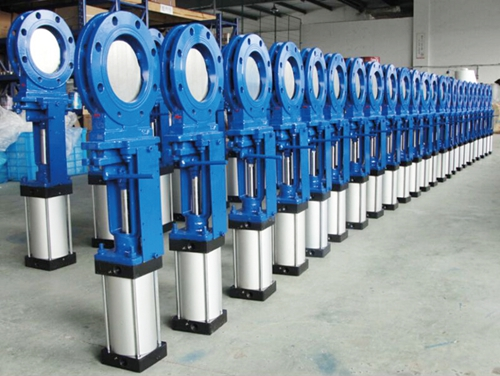
Walk onto any processing floor and you’ll hear the same refrain: “Our line is different.” And it usually is. A valve that cycles twice a minute in a clean, dry plant has little in common with one that slams shut every ten seconds in a dusty mine. Custom trim lets you tune the internals — disc profiles, seat angles, cage geometries — to match the exact flow, pressure drop, and media characteristics you actually face, rather than settling for a catalog compromise that works just well enough.
Seats often get treated as an afterthought, yet they’re the first point of failure when solids, temperature swings, or chemical attack show up. A soft seat that seals perfectly on water can turn brittle in steam or swell in hydrocarbons. Hard metal seats, on the other hand, tolerate abrasion but demand precise lapping and higher actuation force. By matching seat material and design to the real operating envelope — not the spec-sheet ideal — you extend maintenance intervals and avoid the frustration of a “standard” valve that leaks after a month.
Actuators are where customization really pays off. A spring-return pneumatic unit might be perfect for fail-safe isolation, yet useless for throttling with a slow, variable signal. Electric actuators give you position feedback and zero air consumption, but add cost and thermal limits. The right approach starts by asking what the valve must do when power fails, how often it must stroke, and what position accuracy is truly needed. Only then do you pick the actuator, rather than forcing an off-the-shelf pairing to survive conditions it was never built for.
Inside the Test Bay: Every Valve Faces Its Worst Day Before Shipping
The test bay is not a showroom. It is where every valve gets pushed until it begs for mercy—and then pushed a little more. Pressure spikes, thermal swings, and corrosive media hit the assemblies in sequences that mimic decades of service in a matter of hours. Nothing gets a free pass. If a stem seal weeps at the wrong moment or a seat lets go under a surge, the valve goes back to the bench, torn down, and rebuilt. Only the ones that survive the abuse leave with a shipping label.
Some factories sample a few units and call it a day. This place does the opposite. Every single valve that comes off the line goes into the bay and gets the worst day of its operational life forced on it before it ever sees a pipeline. The crew runs custom cycles based on the valve’s intended role—cryogenic chill-downs for LNG service, high-cycle actuation for automated control, and slurry dumps for mining duties. They log every variable, not for a brochure, but because a missed micro-leak today turns into a failure report in some plant six months down the road.
The result is a short bench between test and truck. Valves that pass are dry, tagged, and bolted to their shipping skids within the hour. There is no “good enough” pile. Either the valve holds its rated class under conditions worse than any field install will throw at it, or it never leaves the building. That is the whole point of the bay—make the first failure happen here, where it costs a gasket and some labor, not a shutdown and a lawsuit.
Metallurgy Matters: From 316 Stainless to Ductile Iron
The choice between 316 stainless steel and ductile iron rarely comes down to strength alone. Both alloys handle demanding mechanical loads, yet they occupy different corners of the metallurgical map. 316 stainless leans on chromium, nickel, and molybdenum to build a passive oxide layer that shrugs off chlorides, acids, and marine atmospheres. Ductile iron, by contrast, uses spherical graphite nodules to interrupt crack propagation, offering a toughness that traditional gray iron simply cannot match. Understanding where each material shines means looking past datasheet tensile numbers and asking how the part will fail, corrode, or vibrate in service.
316 stainless earns its keep in environments that punish ordinary steel. The molybdenum addition, typically 2 to 3 percent, is what separates it from 304 when exposed to salt spray or chemical processing streams. Welders appreciate its low carbon variant, 316L, because it resists intergranular corrosion after welding without post-weld annealing. That reliability comes at a price: machining 316 is slower, tool wear increases, and galling can occur if fasteners are not lubricated. Still, for food contact surfaces, pharmaceutical piping, and coastal hardware, the combination of cleanability and pitting resistance justifies the extra cost and fabrication effort.
Ductile iron answers a different set of demands. By adding magnesium to molten iron, foundries coax the carbon into rounded nodules instead of sharp flakes, giving the material a ductility and impact resistance closer to steel while keeping cast iron's fluidity and damping capacity. Pump housings, gear blanks, suspension components, and heavy machinery frames all benefit from its ability to swallow vibration and survive cyclic loading. It is also far cheaper to cast than to machine an equivalent 316 stainless shape, which matters when production volumes climb. The trade-off is corrosion: ductile iron needs coatings, cathodic protection, or careful fluid chemistry to avoid rusting. Neither material is universal, but matching the alloy to the operating environment, rather than defaulting to "stainless is better," separates a durable design from an expensive misstep.
Mining, Wastewater, and Pulp: Where the Factory's Valves Earn Their Keep
There's a reason valves in mining never get a day off. Slurry thick enough to chew through standard seating, pH swings that turn lesser alloys into rust flakes, and pressure spikes that would send a cheap casting into early retirement—these are the daily realities. The valves that survive here aren't just picked from a catalog; they're chosen like you'd choose a crew for a long haul: by what they can take when everything else is falling apart.
Over in wastewater, the problems wear different boots but kick just as hard. Grit, rags, and the occasional mystery object that should never have been flushed all funnel toward the same pinch points. A valve that seats tight against solids without jamming, that can cycle a few thousand times without losing its seal, that doesn't mind a little hydrogen sulfide in the air—that's what keeps a treatment plant from turning into a very expensive pond.
Pulp mills add their own twist. Hot black liquor, chlorine dioxide, and fiber that mats like felt inside any crevice. Valves here need to close with enough force to cut through pulp stock, yet stay easy enough to operate when the actuator is covered in mill grime. It's not glamorous work, but it's exactly where a factory's valves stop being a commodity and start earning their keep.
Less Wrench Time: How Smart Design Cuts Maintenance Costs
Maintenance budgets often balloon not because parts are expensive, but because technicians spend hours reaching a single bolt or draining a system that was never meant to be serviced quickly. Smart design flips that equation. When engineers place wear items up front, standardize fastener sizes, and leave room for common tools, the time spent per repair drops sharply. It's not about making machines simpler; it's about respecting the person who has to fix them at 2 a.m.
Consider a hydraulic manifold buried behind three layers of guarding versus one mounted on swing-out hinges. The smart version might add a few dollars in hinges and a longer hose, but it eliminates forty minutes of disassembly every time a filter needs changing. Over a fleet of fifty machines, that's thousands of hours returned to production each year. Smart design treats every future maintenance minute as a cost that can be designed out before the first unit ships.
The savings also compound through fewer mistakes. When components are easy to reach and clearly labeled, technicians are less likely to misroute a line or strip a thread in a tight space. Downtime shrinks, rework vanishes, and the maintenance team stops dreading certain models. In the end, the best way to cut maintenance costs isn't to train people to be faster—it's to give them a machine that doesn't fight back.
FAQ
The factory uses heavy-duty cast iron and stainless steel bodies with hardened gate edges, so the valves hold up under abrasive slurries, high pressures, and frequent cycling without leaking or jamming.
Mining, wastewater treatment, pulp and paper, chemical processing, and power generation are common, especially where thick media or solids would clog standard valves.
Yes, they handle non-standard dimensions, special flange drilling, higher pressure ratings, and custom coatings or actuators based on site conditions.
Every valve is pressure-tested and dimensionally inspected before leaving the floor, and material traceability is documented for each batch.
Options include replaceable elastomer sleeves, metal seats, and PTFE or EPDM liners, so the sealing matches the specific chemical and solids load.
They excel in on-off isolation, but with a V-port or notched gate and proper actuator control, some models can handle throttling in less extreme conditions.
They offer installation guidance, spare parts kits, and field service support, plus maintenance training for plant crews.
Many standard configurations are kept in semi-finished stock, allowing expedited assembly and shipping within days for critical downtime situations.
Conclusion
A knife valve earns its reputation only when slurries, scale, and suspended solids do their worst. This factory builds each unit around that reality, pairing hardened gates with full-bore passages so thick media keep moving instead of packing into seats. Trim, packing, seat materials, and actuators are matched to the process rather than pulled from a fixed catalog. Before anything ships, every valve is cycled under pressure and exposed to the same abuse it will meet in the field—leaks, sticking, or seat damage get corrected on the test stand, not on a customer's pipeline. Material selection starts with the fluid: 316 stainless for corrosive streams, duplex alloys where chlorides bite, and ductile iron when cost and strength must balance.
That focus carries into the places these valves actually work—mining tailings, wastewater sludge, and pulp stock lines where downtime is measured in lost production. A clean, unobstructed gate path and replaceable wear parts mean crews spend less time breaking torque on packed bonnets and more time running the process. Instead of fighting a seized handwheel or swapping out an entire valve body, maintenance often comes down to a quick seat or packing change. The result is a shutoff point that holds tight, opens fully, and keeps maintenance budgets predictable across demanding industrial applications.
Contact Us
Contact Person: George
Email: [email protected]
Tel/WhatsApp: 13863633883
Website: https://www.es-fire.com